In August 2025, the Arrive AI team (NASDAQ: $ARAI) applauded the news that the FAA will allow drone use for beyond visual line of sight (BVLOS) operations.
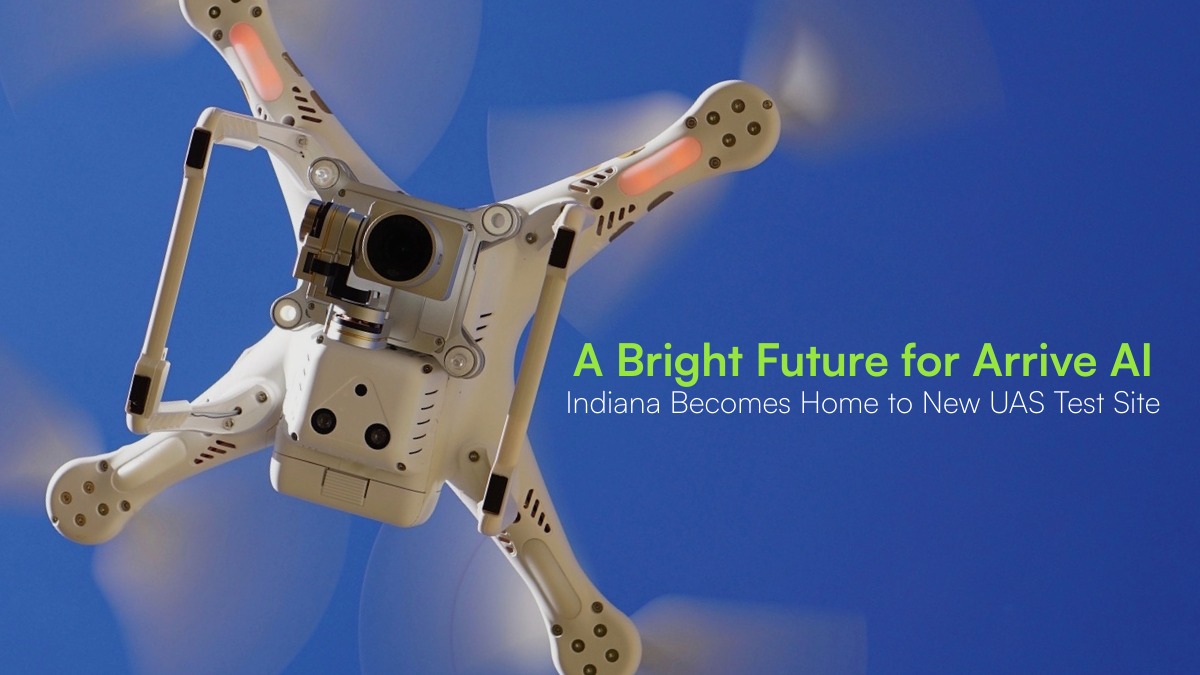
Fast forward to January 7, 2026, and the DOT and FAA announced that Indiana will be the home of one of two new Unmanned Aircraft System (UAS) test sites. These are the first new test sites in nearly a decade, bringing the total to nine in the US.
This is a major development that signals Indiana could become a significant player in the era of “American drone dominance.” This is promising news for Arrive AI, given that the expansion of our autonomous delivery network relies in part on advances in drone technology, specifically drone delivery capabilities, and on an increase in drone usage nationwide due to fewer regulatory restraints.
“These test sites help the U.S. assess emerging technologies to modernize methods for cargo delivery, Beyond Visual Line of Sight Operations, and multiple drone operations while informing safety and security,” - FAA Administrator Bryan Bedford.
Arrive AI is not the only pioneering company that stands to gain from this move by the DOT and FAA. Indiana is set to reap substantial economic benefits in the coming years now that drone testing has become a priority in the Hoosier state.
However, when a place becomes a national UAS test site, the upside goes beyond a boost in the regional economy and extends into five major buckets:
This designation has the potential to usher in an organized ecosystem for the development, testing, evaluation, and data collection of drones to support their integration into the National Airspace System (NAS). That ecosystem will create a demand for a variety of positions and projects within flight ops, engineering, R&D, cybersecurity, airspace coordination, logistics, and more.
Indiana is uniquely positioned to help integrate the UAS into the NAS because of its numerous airspace testing assets and facilities that extend from Purdue University down to Southern Indiana.
Purdue has the potential to become an anchor in the development of Indiana’s drone testing capabilities, thanks to its university-owned airport (the country’s first) and the largest indoor motion-capture system in the world at the Purdue UAS Research and Test Facility (PURT).
Purdue could serve as the “front end” for innovation, where autonomous drone concepts turn into measurable performance through controlled experimentation, repeatable trials, and flight operations that produce the kind of data regulators and industry partners trust. That includes work such as BVLOS-ready operational design, detect-and-avoid evaluation, navigation assurance, secure communications, and safety-case documentation that helps move drones from demos into deployable infrastructure.
The potential payoff is huge, as Purdue’s involvement can help Indiana convert a federal designation into an end-to-end pipeline:
Research → Prototyping → Validation → Pilots → Commercialization
That could create a stronger talent magnet for students and faculty, more sponsored research and industry partnerships, and more startup/licensing pathways that keep intellectual property and high-skill work anchored in Indiana.
In other words, Purdue participation could increase the state’s capacity to learn faster, prove more, and scale sooner, which is ultimately what makes the entire testing network economically, strategically, and civically valuable.
Southern Indiana has three major assets that can help turn Indiana’s UAS test-site designation into an operating network. The region is home to critical infrastructure and technologies you need for serious testing:
With these assets, southern Indiana could enable objective-focused drone trials. The kind of trials that generate credible data for BVLOS, cargo concepts, multi-drone coordination, and the operational “rules of the road” that will ultimately determine what scales nationwide.
For Arrive AI, this development lines up almost perfectly with what the company is building: the “last-inch” infrastructure that makes autonomous delivery practical, secure, and asynchronous.
Arrive AI’s Arrive Point™ is explicitly designed to work with people, ground robots, and drones, adding features that make scaled autonomy viable, including:
As BVLOS rulemaking and test-site data push the industry toward normalized long-range drone ops, Arrive AI benefits because its business model, product, and software address the issues that drone delivery regulators and operators care about most: verified delivery, secure containment, and auditable custody from drop-off to pickup.
We’ve already proven the asynchronous model in high-stakes settings (like hospital logistics with autonomous robotics), which becomes even more effective when drones start plugging into the same autonomous delivery network.
The future of drone operations and delivery is being shaped rapidly, and Arrive AI is ready to provide the missing piece that will accelerate the creation of a nationwide autonomous delivery network.
Discover our delivery solution that’s smart, secure, and built for the future.