Autonomous technology is no longer theoretical.
In recent months:
Billions are pouring in. Adoption is accelerating. Public trust is surging. Momentum is unstoppable.
For the first time, it feels like autonomous delivery is truly happening.
But there’s something else happening too: These companies are spending heavily—and not prioritizing long-term profit.
That’s not a flaw. That’s the signal.
If this pattern feels familiar, it should. We’ve seen it before.
Amazon
Spent billions building fulfillment centers before e-commerce scaled.
Invested heavily in infrastructure before monetizing search.
Tesla
Built out its Supercharger network ahead of mass EV adoption—solving range anxiety before demand fully materialized.
In each case, the early years looked the same:
Because they weren’t just building products. They were building infrastructure.
Today’s autonomous delivery leaders—Serve, Zipline, and Wing—are doing exactly that.
They’re not just building:
They’re investing in the foundation of an entirely new logistics system. But there’s a critical piece still missing.
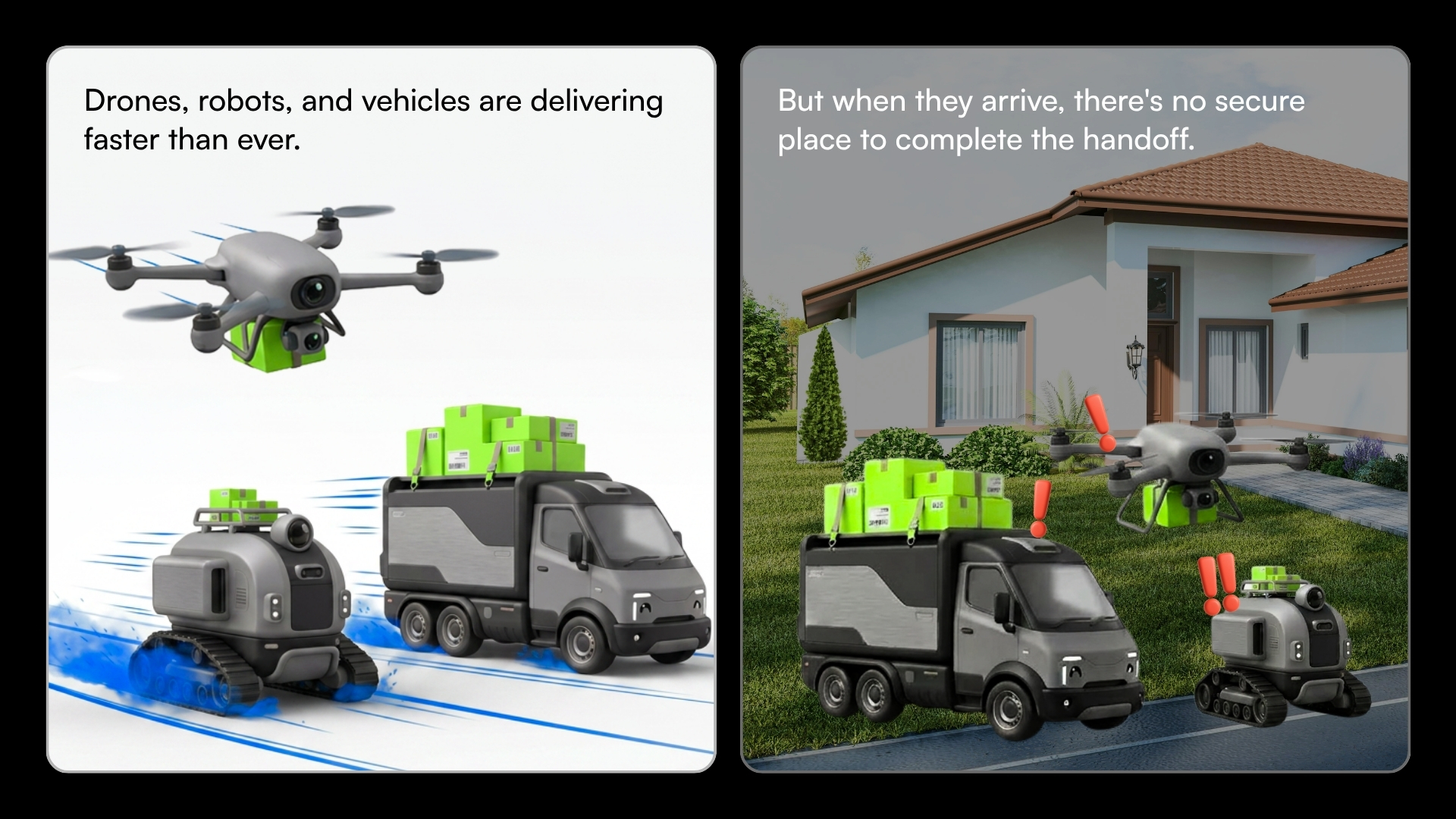
For all the progress in autonomy, one question remains largely unanswered. What happens when the vehicle arrives?
When:
The system still depends on:
In other words, the final step is not autonomous.
For years, logistics focused on solving the “last mile.” But autonomy has shifted the problem. Now the biggest constraint is the last inch of the last mile — the precise handoff moment that determines whether autonomous delivery actually works end to end.
And today, that moment is:
This isn’t just a technical gap—it’s an economic one.
Without solving delivery completion:
Which is why, despite billions invested, the model hasn’t fully flipped yet.
Every major platform transition follows the same arc:
Phase 1: Technology Breakthrough
Innovations (e.g., autonomous vehicles, robots and drones) become viable and disrupt existing markets or create new ones.
Phase 2: Early Deployment
The early majority begin creating opportunities for limited rollouts in controlled environments. This helps refine the new technology and increase its adoption among businesses, governments or the general public.
Phase 3: Infrastructure Buildout (Arrive AI = Infrastructure)
After the dominant designs emerge, reliable infrastructure must be built to bolster their operation and embed them in business and everyday life.
Phase 4: Economic Flip
Society reorganizes and adapts to new technology, leading to widespread adoption, lower costs and expanded margins.
The autonomous delivery market is now entering Phase 3.
To move into Phase 4, the industry needs:
Not better vehicles. Better infrastructure.
The most valuable companies in the world don’t just build products. They build platforms.
Platforms:
That’s why:
The same dynamic is emerging in autonomous logistics.
Right now, the industry is focused on machines:
But long-term value won’t come from individual devices. It will come from networks.
The real question is:
What system do they all plug into?
Arrive AI is building that missing infrastructure layer.
A network of intelligent delivery endpoints—Arrive Points™—that enables:
Every delivery through Arrive Point is logged — routes, timing, and handoff data that builds a clearer picture of how autonomous delivery actually performs across the network.
This transforms autonomous systems from isolated machines into connected participants in a shared network.
Once this infrastructure is in place:
This is when the model shifts from high upfront investment to scalable platform economics.
The billions being invested by Waymo, Serve, and Wing aren’t the story.
They’re the signal.
A signal that:
Autonomous vehicles may define how goods move, but infrastructure will define how the system works.
Because the companies that win won’t just build the technology; they’ll build the platform everything else runs on.
Additional Resources
Investor Relations: Alliance Advisors IR, ARAI.IR@allianceadvisors.com
Media Contact: media@arriveai.com
Stock Ticker: NASDAQ: ARAI